Wednesday, January 11, 2017

Race Reports: Viking Run and RFTH

As part of the buildup for Rocky Raccoon, I recently ran two local, low-key races within a seven-day span.  Not that I particularly needed to race, per se, but both are fun events that I've enjoyed running in the past, and would provide two different training stimuli that I wanted heading into the final training push.  The training has actually been going quite well--averaging over 100 mi/wk for the past couple of months, including recovery weeks, with some good hill sessions, some longish marathon-paced running, and a couple of good long runs (particularly a 40-miler with Phil and Laura that despite the arctic conditions went quite well).  I've had a few little aches and pains, but with help from Greg and Scott I've been staying (mostly) on top of things.

Pre-Viking Run selfie, with obligatory hat.

First up in this little racing mini-block was the Viking Run, a very low-key 10K in Rosendale, about 10 miles from my house.  This race has been going on for much longer than I know; when I moved to the area in 2004, it was already a staple of the local scene.  It's generally held on the weekend before Christmas and New Year's; the 2016 edition took place on New Year's Eve.  We're often out of town during this vacation week, but I like to run this race if I'm around; this was my fourth or fifth time running it, but the first since 2014.  Generally, I can run up front if no fast young guys show up, which was the case this year.  I showed up after an overnight shift at the tail end of a 100-mile week, hoping to break 40 minutes, which on this course, which features over 1000 feet of climbing, is actually a pretty good effort.


I started off at the front and immediately opened up a small gap of about 10-15 seconds during the first mostly flat mile.  Tim Kosteczko, a local runner who's been putting in some good training recently, was hanging tough in the early going, but I was pretty sure that once the climbing started I'd be able to pull away.  We hit the first hill just past the mile mark and proceeded to climb for the next 10+ minutes; by the time I reached the top I couldn't see Tim behind me.  The course then drops precipitously for about a mile, turns around, and retraces its way back to the start.  I had a two-minute lead at the turn and knew I was pretty safe in terms of the win, but continued trying to push myself for the sub-40.  The return climb is absolutely brutal, and I struggled near the top, but was able to recover quickly on the way back down and hold on for a 38:55 and a three-minute victory margin.  This year, for the first time, local running nut Chris Regan had awards made for the race, and I wound up taking home a pretty cool viking horn trophy, out of which I imbibed a few that evening.

Cool! Thanks, Chris.
One week later, finishing a 120-mile training week, I returned for the fourth time to the Recover From the Holidays 50K, another low-key local event that I love to use as a workout/tuneup if I'm running a big race in the middle of the winter (which I usually am).  RFTH is a fat-ass race comprised of ten laps of a paved 5K out-and-back circuit.  This was actually the 21st running of this event, which is mostly used as a training run for local distance runners; RDs Pete Colaizzo and Charlie Sprauer will let anyone show up and run as many or as few laps as they like.  Most folks will run their 10-15 mile long run for the day and sit around the bonfire eating pizza with Pete and Charlie afterwards, but each year about 10-20 folks will battle the cold (and wind, and usually snow flurries) for the full ultra.  There are no awards, but it's free, as is the pizza, so you can't beat that price.

I'm on an odd-year-only streak with RFTH.  It's a race I've tried to do every year, but in the even years, something seems to get in the way.  (Last year it was Bandera.)  Still, I had secured wins in 2011, 2013, and 2015, and while it's certainly a casual event, 2017 marked my chance to become the first four-time winner of the race.  Among a champions' lineup that includes US national team members (Byron Lane) and American record holders (Sabrina Little), that would be a pretty cool deal.

Despite the recent heavy training volume, my legs have been feeling pretty good, and my goal was to run a relaxed but steady tempo of about 22:30/lap--right around 7:30 pace--shooting for a 3:45.  I figured my current fitness level would allow me to run that pace without too much difficulty and without sacrificing the last few weeks of my Rocky Raccoon training.  My friend and training partner Brian Hickey, who has won this race twice himself, was joining me there, but was aiming for 8:00/mile pace, so unfortunately it looked as though I'd be on my own.

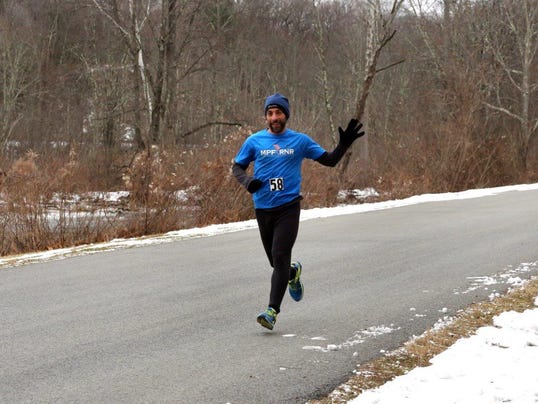
Rolling along at RFTH
photo: Charlotte Kopp
We started off on a frigid 19 degree morning and I immediately opened up a small lead on Brian and the rest of the pack.  I struggled through the first lap just trying to warm up; my toes were completely numb and my teeth were chattering through the early stages.  I ran the first lap in exactly 22:30 and was already over a minute in front.  About halfway through lap two I finally felt as though I had warmed up and was able to settle into a comfortable rhythm of right around 22:00/lap.  As I clicked off the miles, everything felt rather comfortable.  I didn't quite have my climbing legs, but I was able to power through the hills, as they are relatively short, and was really able to hold a nice, quick tempo on the flats.  I passed 15K in 66:30, halfway in 1:50:15, and 30K in 2:12:35.  Starting at about lap three, I checked the port-a-potty each time past the start/finish, but couldn't catch a window when it was open; finally, after reaching 35K in 2:34:50, I stopped and waiting until it opened up.  Finishing my business, I started lap eight at 2:36:55, cruised through 40K in 2:57 and the marathon in right around 3:06.  Finishing up lap nine in 3:18:30, and still feeling very relaxed, I decided to push the final lap slightly to see if I could break 3:40.  It did take a little more effort over the final circuit, but I was able to run my fastest lap at the end and finish up in 3:39:20, my second-fastest time on the course (after a 3:32 in 2013) and ninth-fastest all time.  My final 15K was my fastest three laps of the day, covering that stretch in 63:30 (6:50 pace).  All in all, a great confidence boost heading into the final buildup to Rocky.

I'll have a couple of brief posts coming in the next couple of weeks prior to RR100, and hopefully a good writeup following it.  After that the blog may have to go quiet for a few weeks.  I'm finishing up classwork this spring while simultaneously starting a new work project and writing a scientific paper that needs to be finishes by mid-March, so things are going to get pretty hairy in there for a little while.

Thursday, January 5, 2017

Why Economy Matters


I'm currently working towards a post-graduate certification in exercise science from California University (go Vulcans!) and so I've been doing a fair bit of reading in recent weeks.  Not all of my studies have been terribly applicable to distance running, but I've been able to glean some pearls.  I've experienced a renewed appreciation of the importance of strength and core training, for example.  And while I'm becoming more comfortable with the concepts of VO2max and lactate threshold, which are the mainstays of scientific inquiry into endurance athletes and their training, I'm beginning to think that the less-discussed parameter of running economy may actually be the most important physiologic variable, particularly in the ultra world.

A quick primer, for those who may not be familiar with some of these terms.  Most athletes who have been tested in a lab will have a general sense of their VO2max and lactate threshold.  VO2max refers to the maximum uptake of oxygen by muscles that are exercising at peak intensity.  Running performance is dependent upon a wide variety of factors--the ability of the system to remove lactate, buffer excess acid, and dissipate heat, as well as various neuromuscular and biomechanical considerations--but at its most basic level, endurance performance is governed by the ability of the cardiopulmonary system to distribute oxygen to the skeletal muscles, and on the ability of the muscles to most effectively and efficiently utilize that oxygen.  These crucial components--oxygen delivery and oxygen utilization--are encompassed by the VO2max.  

The lactate threshold (LT) is the exercise intensity beyond which lactate production begins to outstrip lactate clearance.  This is an important determinant of running performance, as it represents the highest intensity that can be maintained over a long period of time.  The higher the LT, the faster an athlete can run without accumulating significant amounts of lactate, which will lead to fatigue.  (This is a fairly simplified explanation, but it will serve the purposes of this rather unscientific blog post.)

OK, then, what's running economy?  Running economy (RE) refers to the muscular uptake of oxygen while running at a sustained, non-maximal pace. It is a measure of how efficient an athlete is when running at "steady-state"; one could think of RE as the VO2sub-max.  Or, compare it to a car: if VO2max is the size of the car's engine, RE is the gas mileage. 

When you think of RE in this way, it becomes clear why it is such a crucial aspect of endurance performance.  While VO2max holds an important key to an athlete's potential, the runner who demonstrates better running economy will be able to perform at a higher relative percentage of her VO2max without fatiguing.  In a marathon or ultra, which takes place at intensities far below maximum effort (unless you're Zach Miller, apparently),


the ability to maintain a higher relative intensity with less effort and less fatigue is going to carry the day.  This is especially true at the upper echelons of the sport, where a relatively high VO2max is basically a requirement for entry.  Yes, there are outliers, and if you're lucky enough to be Killian (reportedly, a VO2max of 89.5 mg/kg/min, one of the highest ever recorded) or Pre (supposedly a VO2max of 85 mg/kg/min), maybe RE becomes less important.  But for the most part, an elite marathoner or ultrarunner will have a VO2max in the high 70s.  So if everyone starts in this relatively rarefied air, economy may become the determining factor in performance.

Put it this way: taken together, VO2max, LT, and RE account for 70% of inter-runner variance in performance.  If whatever contribution VO2max makes to that 70% is basically negated because all of your competitors have that same contribution, the other factors take on outsized importance.

You millennials out there on the interwebs may not know the guy in the picture to start this post.  That's Frank Shorter, winning the gold medal at the 1972 Olympic marathon in Munich.  (He was robbed of a repeat gold in 1976 by Waldemar Cierpinski, a product of the East German doping machine.)  Shorter is notable in this discussion for having a relatively pedestrian VO2max of about 70 mg/kg/min, but he compensated for this by being incredibly efficient--in fact, his RE values compared favorably with most elite East African runners, which helps explain his fantastic success despite having a "normal" VO2max.

So how do you improve your running economy?  Well...we're not 100% sure, although it certainly appears to be modifiable in some ways.  Part of the problem is that RE is determined not just by cardiovascular factors (VO2max) or metabolic factors (LT) or neuromuscular factors, but encompasses all of these and others.  So it can be hard to tease out the effects of various types of training on RE, independent of their effects on the various physiologic systems in play.  Another problem is that RE is, at least in part, dependent on anthropometric/body composition characteristics.  (Not just being lighter, but having long legs relative to torso length, with thinner ankles and calves relative to the quadriceps, which imparts a biomechanical advantage, and which you can't really do anything about.)

The good news is that there is some evidence that almost any kind of training has a positive effect on RE.  Indeed, there is some suggestion that simply cumulative mileage over many years leads to enhanced economy.  (Although on the flip side, RE decreases with age, likely due to a reduction in the ability to store and use elastic energy...it gets complicated pretty quickly.) And interval (VO2max) training, LT training, and resistance training have all been shown in various studies to improve RE, though the relative benefits of training at various intensities remain unclear.  Resistance training has demonstrated positive effects on RE, although again, we have yet to define the optimal method by which this takes place.

So, your take-home points:
  1. when you go to your friendly exercise physiologist for an assessment, ask about your RE, not just your VO2max and lactate threshold
  2. include various intensities in your training to improve RE via multiple pathways
  3. don't neglect strength training; not only has it been shown most definitively to improve RE, but it will help keep you injury-free
  4. Zach Miller is a fucking animal
If you're interested in this stuff, and want to read a much more coherent explanation of these variables than I can provide, try this post from the inimitable Ross Tucker.


Wednesday, December 21, 2016

Race Report: SOS4Kids


Sorry for the delay--this race took place over three months ago--but the munchkins take over the blog again to bring you their latest report:

This was the second triathlon I've done.  This was my first triathlon.  I ran / swam / biked a greater distance than she did. I swam eight laps, ran one mile, and biked four miles, and then ran another quarter of a mile.  I swam four laps, then ran half a mile, biked two miles, and then ran another quarter of a mile.  When I was at the first running part, a lot of stuff hurt, but only a little. However, when I got to the biking part, my legs started hurting a lot.  In the biking part of the race, I was kind of annoyed because I didn't have gears and I'm pretty sure that everyone else did.  During the bike, I felt like I had missed the turn around, because all of the uphills and downhills made the whole race seem a lot longer. I won a silver medal in my age group.  I was feeling great at the end of the race. I won a third place medal in my age group.

-Lexi and Dylan


Tuesday, December 13, 2016

Ultrarunner of the Year: My Ballot

This was the second time I was asked to vote for Ultrarunning magazine's Ultrarunner of the Year award, and I found this time around much harder than the first.  The men's and women's UROY were pretty obvious choices, but beyond that, narrowing down the rest of the top ten was exceedingly difficult.  Not to mention parsing the myriad fantastic races run this year to come up with the five best Performances of the Year.  And of course, just when I had settled on just about everything, last weekend happened and OH MY GOD.  It was pretty much back to the drawing board Monday morning.

One thing that made it a bit easier--or maybe harder?--was that for the first time, we were explicitly instructed by the powers-that-be that Fastest Known Time performances (FKTs) were not to be considered among the criteria for deciding UROY or POY.  This meant that several of the top contenders for POY, particularly on the men's side--Jim Walmsley's incredible R2R2R FKT, Pete Kostelnick's amazing transcontinental record, Karl Meltzer's FKT on the venerable Appalachian Trail, Jacob Puzey's 50 mile treadmill WR--were all out.  (For me, that effectively took Pete and Karl out of the running for UROY as well, though it didn't effect Jim's candidacy at all.)

There are about thirty voters, and the results are still being tabulated; the final results will be released on the Ultrarunning website starting in about a week.  For what it's worth, here are my picks.

Women's UROY
1. Kaci Lickteig
2. Magdalena Boulet
3. Caroline Boller
4. Courtney Dauwalter
5. Sarah Bard
6. Amy Sproston
7. Camille Herron
8. Maggie Guterl
9. Hillary Allen
10. Darcy Piceu

I found this category to be the toughest of all to compile my ballot.  This past weekend made it almost impossible; after Kaci, who was untouchable in 2016, I agonized over just about every spot on this list.  Toughest omissions for me: Katalin Nagy, Pam Smith, Gina Slaby, Devon Yanko, YiOu Wang, Jenny Hoffman, and Alissa St. Laurent.

Women's Performance of the Year
1. Gina Slaby, 100mi WR at Desert Solstice
2. Caroline Boller, 50mi trail world best at Brazos Bend
3. Katalin Nagy, dominant repeat win at Spartathlon
4. Sarah Bard, fourth place at Comrades
5. Hillary Allen, win at Cortina Trail ultramarathon

Felt like maybe I made up a bit here for leaving Gina and Katalin off the UROY ballot.  Tough to leave off Maggie's 100mi performance at Brazos Bend last weekend, Kaci's dominant win at Western States, and Cassie Scallon's course record at Bandera.

Women's Age Group Performance of the Year
1. Meghan Arbogast (55 years old), 100K age group WR at IAU World Championships
2. Meghan again, sixth place at Western States
3. Connie Gardner (52), win at Mohican 100
4. Beverly Anderson-Abbs (52), win (3:48) at Jed Smith 50K
5. Debra Horn (52), 170 miles in 48 hours (and the win) at Across the Years

Meghan's world age group record was an easy choice for me here, though I continue to have difficulty evaluating all of these performances across different age groups.

Men's UROY
1. Jim Walmsley
2. Jeff Browning
3. Zach Miller
4. Alex Nichols
5. Ian Sharman
6. Hayden Hawks
7. Dylan Bowman
8. Cody Reed
9. Brian Rusiecki
10. Andrew Miller

Just like for the women, Jim was an easy pick for the top spot; I'd honestly be a little surprised if he doesn't win unanimously.  And, just like the women, the next nine spots were a nightmare.  Almost too many difficult omissions to count; the toughest: Zach Bitter, Dave Laney, David Riddle, David Roche, Paddy O'Leary, Chase Nowak, Patrick Regan, Tim Tollefson, and Aaron Saft.

Men's Performance of the Year
1. Zach Bitter, 100mi American Record at 2015 Desert Solstice
2. Jim Walmsley, course record at JFK
3. Jim Walmsley at Western States
4. Tony Migliozzi, repeat winner at IAU 50K world championship
5. Tim Tollefson, third place at UTMB

Honestly, this was even harder than the women's POY for me.  Trying to choose between Walmsley course records was a thankless task; JFK got the nod given the history of the race, the number of legends who have taken on that course, and the fact that no one is within two fucking miles of that performance.  I couldn't leave off Jim's race at States either, which was the single most talked-about performance of the year, and the most dominant display that I've ever seen.  It may not be fair, but that's my vote.  I do hope Zach winds up winning this; it's unfair that people have kind of forgotten about DS last year, which was too late for 2015 voting.  Toughest omissions here were Zach Miller's crazy battle and win over Hayden Hawks at North Face, Jim at Bandera, Jim at Sonoma, Jason Schlarb at Hardrock, Geoff Burns' 6:30 100K at Mad City, and Patrick Regan's third place finish at IAU 100K worlds.

Men's Age Group Performance of the Year
1. David Jones (65 years old!), 17:34 100 mile at Tunnel Hill
2. Rich Hanna (51), age group national record (3:17) at Jed Smith 50K
3. Jean Pommier (52), 3:18 at Caumsett 50K
4. Ed Ettinghausen (57), 270 miles in 72 hours at Beyond Limits
5. Roger Jensen (66), 7:59 for 50 miles at JFK

You really could make an argument for any of these to be at the top of the list for me, and I wouldn't disagree with you.

So there you go.  Feel free to tell me what an idiot I am.  If you do, though, you must vote for me for Run Ultra's Blogger of the Year.  If you vote, you can go to the comments and call me whatever names you want.

Wednesday, December 7, 2016

The Importance of Being a Furnace*


"If the furnace was hot enough, anything would burn, even Big Macs."

"And too, there were the questions: What did he eat?  Did he believe in isometrics?  Isotonics?  Ice and heat?  How about aerobic, est, ESP, STP?  What did he have to say about yoga, yogurt, Yogi Berra?  What was his pulse rate, his blood pressure, his time for the 100-yard dash?  What was the secret, they wanted to know; in a thousand different ways they wanted to know The Secret."

--John L. Parker, Jr.

It seems like I can't escape diets.  Everywhere I look I'm reading about people's diets.  My Facebook feed is full of pictures of what all my ultra running friends are eating.  In interviews, the elite runners I listen to are constantly being asked about their diets.

Why?  Part of it is the American obsession with diet, sure, but it's more than that.  As the sport gets more competitive, we're all looking for an edge; that's part of it too, the hope that we can find an advantage, the secret.  But there's another factor at play, too: it seems like people want to tell other people what they are eating, and why everyone else should eat that way too.  This may be due to the economics of ultra running, still in its infancy as a professional sport for some; sponsorships in many cases are tied to an athlete's social media profile, and all those bloggers need something to write about.  (Guilty as charged.)  And social media by its very nature encourages this sort of food-based voyeurism.  (Though maybe you should stop.)  But there seems to be a proselytizing aspect to it as well, particularly in the ultra world; not only to people want you to know what they're eating, but they  want you to know that you should be eating that way, too!

I'm reminded a bit of the minimalism craze of the late aughts, after Born to Run came out, and everyone wanted to tell you (rather loudly) why you, too, should be running in Vibrams.  The two cases share some similarities.  In both, there is a lot of research out there that can be conflicting and confusing, and the scientific community can't seem to reach a consensus.  Acolytes on all sides of each issue spout one-size-fits-all solutions.  And interestingly, both problems seem like they should have a universal solution.  I mean, shouldn't there be an ideal diet to optimize performance?  Shouldn't there be an ideal way to run, to minimize injury?

But the fact that so many people are finding success with so many different approaches would imply that there is no universal answer.  There are world-class athletes on paleo/LCHF/OFM diets (Zach Bitter, Jeff Browning, Tim Olson, Nikki Kimball);  on vegetarian diets (Sage Canaday, Scott Jurek, Mike Wardian); on vegan diets (Sandi Nypaver, Yassine Diboun); on gluten-free diets (Devon Yanko); on gluten-free AND vegan diets (Laura Kline, probably some hamsters); on all-fruit diets (Denis Mikhaylove, Mike Arnstein), and everything in between.  I think the common denominator is not what these people are eating, it's that they've all found what works for them.  There are arguments to be made for almost any diet.  We have enough trouble identifying what a healthy diet is for regular people, let alone defining what ultra-endurance athletes should be eating to maximize performance.  The more I read and hear, the more I think that the specifics of what you eat don't matter.  What matters is that you're paying attention to it.  If you are cognizant of what you're putting in your body, of what is does to you, of how it makes you feel and how it affects your performance, you're going to figure out what works for you.  And that's the secret.  That's where the advantage is.

Having said all that, here's what I've been eating.

This is not to say what you should be eating.  I may be a hypocrite, but I'm not going to go on a rant about people telling other people what to eat and then contradict myself two paragraphs later.  (You'll have to wait at least two, three posts for that.)  This is because since I've started to pay attention to my diet, at the beginning of last year, and have found something that, for now, works for me, people have been asking me about it.

At the start of 2015, I started following a low-carb, ketogenic diet.  (I hesitate to say "high fat," because I'm not sure that I'm actually getting the 60-70% of calories from fat that most "experts" would recommend.)  There were several factors in play when making this decision.  Primarily, I wanted to be more mindful of what I was eating, to help control my weight and to aid in performance.  I wasn't overweight by any stretch, but at 5'6", I was having trouble staying under 145 pounds, and wasn't anywhere near the 135-lb race weight from my collegiate days that I thought was most beneficial for my running.  I had done some reading and talked to several people who had experienced success with the diet, and the scientific theory behind it seemed, at least, plausible to me.    And, crucially, (and in contrast to calorie-counting, vegetarianism, fruitarianism, etc.), it seemed like something I could adhere to for an extended period of time.

My experience with the diet mirrored a lot of what I had heard and read.  At first, I felt pretty crummy and my running went in the toilet for about three weeks.  After that I started running normally.  I lost weight and was able to keep it off without starving myself.  And I found in races that my energy levels stayed much more stable, and I was much less prone to "bonking," despite taking in fewer calories than I had previously.

I mentioned it on the blog, and a few people were curious, but then I started running well, and people started to get really curious. ("What was the secret, they wanted to know...")  Some of the more common questions:

Why do you eat that way?  What's the theory behind it?
I've mentioned above why I started with this diet; click the link for a longer discussion of my own personal reasons for the switch.  The science behind a low-carb diet for athletes, which certainly in dispute, makes sense (to me at least) in theory.  For strenuous exercise, the body depends primarily on carbohydrates, and is most efficient at using carbohydrates as fuel.  You can burn fat, but if you eat a standard diet, probably not efficiently enough to use it as a primary fuel source, particularly in races.  Why does this matter?  Well, your body can store about 2000-2500 kcal of carbohydrate (in the form of glycogen).  At about 100 kcal/mile (about what it takes to run a mile, regardless of pace, believe it or not), that means you can go about 20-25 miles before depleting your glycogen and needing to replenish it.  For most exercise, this doesn't matter; you can run a marathon, or close to it, without worrying about taking in too many exogenous calories.  But for an ultra, you'll need a lot of calories, and getting those calories in can be a problem.

The theory behind a low-carb diet is that, over time, if deprived of carbohydrates, the body will actually become more efficient at burning fat--almost as efficient as it is at burning carbohydrates.  And the body stores way, way more calories as fat than it does as carbohydrates, like twenty times more.  The thinking is, if we can tap into those fat stores efficiently, we give the body an alternative fuel sources as races reach beyond the 2-3 hour mark, and decrease our reliance on taking calories in as we run.

Now, whether or not that's true is a matter of great debate.  (As is whether or not eating a low-carb diet is even necessary to become "fat-adapted" in the first place.)  But many athletes have anecdotally reported that they are able to run longer despite taking in fewer calories after switching to the diet.

What do you eat?
This is an easy one because it never really changes.  For breakfast, scrambled eggs with cheese, or an omelette with cheese and tomato, and usually bacon or some meat.  For lunch, a salad with whatever fat or protein I can put on it (cottage cheese, turkey, pork, hard-boiled eggs, etc.).  Dinner is almost invariably some sort of meat dish: chicken with vegetables, steak, burger without a bun.  Lots of vegetables with creamy dressings or dips.  Snacks are nuts (peanuts aren't the best choice, but they're really the only nuts I like) or cheese, maybe some lunch meat.  Dessert is whipped cream.  I mean, like, straight whipped cream, right out of the can.  I can kind of go overboard with it sometimes, but even half a can is less than 20g of carbs, and usually 3-4 mouthfuls will satisfy the sweet cravings.  I drink water and Diet Coke.  Once in a while I'll drink a low-sugar hot chocolate (that's like 4g of carbs).  I know Diet Coke is terrible for me but what else can I do?  I've tried to like coffee and tea so many times and I just can't do it.

How many/few carbs do you eat?
I'm not really sure.  A big part of my success with the diet is not being overly scientific or strict about it.  Many people I know track their carbs obsessively, but I know myself, and if I tried to be anal about it, there's no way I could ever stay with it.  (I downloaded an app to track my different "macros" but had to give up after a day.)  The recommendations I read from Phinney and Volek (which is a very good starting point in my opinion) is less than 50g/day for the first 2-3 weeks, then under 100g/day for "maintenance."  I can say with some confidence that I'm well below those guidelines, but I'm not zero.  If I had to guess, I'm probably usually in the 30-40g/day range.

Were you/are you able to train on that?  Do you use carbs in training or racing?
As I said before, it took me a good 3-4 weeks before I could really train the way I wanted to.  I was able to run mileage without a problem, but any kind of intensity--even just running slowly uphill--was a giant struggle.  This passed after about a month and then I was back to normal in terms of my training.  But it was a frustrating time.

I don't use carbs in training.  Many low-carb athletes do, including Zach Bitter, who uses specific carbs for specific, targeted workouts.  I don't do that for a couple of reasons.  For one, I'm a bit leery of jumping on and off the carbs.  In general, when I've taken a "cheat day" or had a couple of beers, I won't notice any ill effects, but I'd rather not make a habit out of it.  (Plus, if I'm going to have carbs, I want to really glutton it up.  You know, pizza, ice cream, the whole deal.  I'm not wasting carbs on a baked potato.)  Second, I don't like assigning a ton of value to any specific workout, to the point where I feel like I need the carbs to get the workout done.  If the workout doesn't come off like I want it to, so be it.  But mostly I just need to keep this simple.  Complicating it by adding carbs "strategically" is just another barrier to me sticking with it.

I do use carbs in racing, though, as many (if not most) low-carb athletes do.  My general race strategy is, a carbo-load the night before (to top off the glycogen stores); no carbs for breakfast--eggs and meat, as usual--and no carbs for the first hour of the race (usually just water).  After that, anything goes.  Gels still work fine for me, and I'll do some real food at aid stations--banana, PBJ, pretzels, broth, whatever.

I've heard that after you stop eating carbs and sugar, your body doesn't even want it anymore.  Is that true?
Ha.  Hahahahahaha.
No.

Does it really work?
Dunno.  It works for me.

*My apologies to Oscar Wilde.  I wanted a pithy title.

Thursday, December 1, 2016

Blogger of the Year!


Not to toot my own horn, but...well, yes, to toot my own horn.  I'm very excited (and confused) to announce that I've been shortlisted by RunUltra for their (prestigious?) Blogger of the Year award.

Honestly, this is a great honor, and I'm a bit humbled by my inclusion (though not too humbled; I'm still kind of an insufferable jerk about this sort of thing) on a list of many great blogs which I myself enjoy.  However, I'm certainly not so humbled that I don't want to win!  So if you enjoy my (and Lexi's; this whole blog was her idea) ramblings, please consider voting for me.  It's a little confusing; when you vote, highlight my name/blog, then you have to scroll down to the bottom of the page and enter your name and email address.

You can only vote once per email address, and once per computer (or computer user), but if you have multiple users on a computer with separate logins, and/or multiple email addresses, that seems kosher.  So, if you like the blog, please vote.  If you really like it, have your kid/spouse/significant other log on and vote too.  If you love it, vote from your home computer and your work computer.  If you really love it, vote from the computer of the guy who sits next to you at work, then go to your local library on the way home and vote there.

In case you didn't get the hint above, here's the link to vote.

Thanks for the support.  I know you always laugh at actors when they say about an Oscar, "Just being nominated is an honor," but that's actually true, and it's just nice to be recognized among the many other great ultrarunning blogs out there.  But winning is nice too.

Tuesday, November 29, 2016

Fall Racing Recap

Just a quick post to let you know what I've been up to...

Following the North Coast 24 hour, it took nearly a week for the swelling to subside enough to see my ankles again, and another week of sore, easy jogging until I started feeling somewhat back to normal.  Within a couple of weeks, though, I was back on the track, helping Laura prepare for her crack at TNF, and starting to feel pretty good.  With some low-key local events offering a nice opportunity to socialize with friends and training partners, I put together a small fall season to keep myself fresh and engaged in preparation for my next big outing.

Dr. Mike's Doggie Duathlon
photo: Michele Halstead
First up was the inaugural Dr. Mike Doggie Duathlon.  Dr. Mike is one of my great friends and training buddies, and a true legend of the local triathlon scene; he is a multiple-time USAT All-America and has been ranked #1 nationally in his age group.   For the past several years Mike has battled MS, though it hasn't been much of a fight; he basically did not let it slow him down at all, and if anything has actually gotten a bit faster, at least in the running discipline.  Mike put in a great winter of training and was in great shape heading into the spring, only to be blindsided with a diagnosis of metastatic melanoma.  He's battled on and appears to be making great headway, and is still in great shape; I run with him at least twice a week, and he hasn't lost a step despite surgery and chemotherapy.  So this duathlon was a great celebration of Mike and his incredible spirit and determination, as well as a fundraiser for the Melanoma Research Foundation.

My plan was to tune up the CX bike and cruise my way through an easy, fun day at the back of the back.   Unfortunately Phil had other ideas; he had just finished an epic day at Grindstone and wasn't up for running, so he badgered me into joining him on a relay team.  I ran the two 2-mile legs while Phil took care of the 12-mile bike segment.  This was theoretically a great idea, but it ensured that I'd have to run hard to put on a good show/not embarrass myself.  There was a challenge from a young post-collegian on the first leg, and I had to work pretty hard in cold, rainy conditions to split 11:11 for the opening two miles, giving Phil about a 20-second lead.  Phil managed one of the fastest bike splits of the day and gave me back the baton with enough cushion that I could run a relaxed, tempo-type effort on the second leg to secure an easy team victory.

Gump, at the start of the Monster Sprint
photo: Martin Weiner
Eight days later I abandoned Jodi and the girls in the midst of trick-or-treating for the New Paltz Monster Sprint.  Halloween is a big deal in our weird little town, with haunted houses, pumpkin-carving contests, and a huge parade that shuts down Main Street for much of the evening.  This was the second year that the Monster Sprint led off the parade; this is a one-mile out-and-back race from the finish of the parade, uphill to the start of the parade, and back down to the finish.  I figured I'd have a built-in advantage as Forrest Gump, but I didn't count on 4:05 miler Joe Gentsch showing up dressed as the Flash.  I was able to hang with Joe for the opening, uphill half-mile, actually leading for a few strides and making the turn only about three seconds behind, but he put me away quickly and easily on the way back down, running 4:50 to my 5:12.  Second place was enough to nab one of the very cool, real marble, headstone-shaped awards, though, so I was pretty happy with that.

Six days later Laura and I were the co-RDs for yet another ridiculous undertaking, the Apple Cider Donut Challenge.  Following on the heels of the New Paltz Pizza Challenge, we conceived a 50K loop that incorporated stops at six different orchards, each of which made their own apple cider donuts.  Each runner would have to eat two donuts at each stop for a dozen total donuts, or face time penalties for failure to finish them.  Time bonuses were awarded for drinking hard cider at those orchards that make their own.

Four donuts to go.
photo: Martin Weiner
We weren't really sure if anyone else would show up, but as it turned out, ten of us took off on a beautiful Saturday morning to eat our way around New Paltz and Gardiner.  Laura and I ran together and opened up a quick lead after the first donut stop, less than a mile into the race.  The course was mostly road and rail trail, and therefore didn't require any real marking except for one tricky section of trail, about half a mile long, that I had flagged with surveyor's tape the previous day.  Unfortunately, when we reached that section (just before donut stop #2, at the six-mile mark), the marks had all been taken down.  I let Laura run ahead and stopped to escort the rest of the field through that section, which was very difficult to follow due to thick leaf cover; by the time I reached the second orchard with the last of the stragglers, Laura had over twenty minutes on me, with Joe Gentsch (attempting his first-ever run of longer than 16 miles) following close behind her.  I settled into a nice, solid tempo, and eventually reeled in most of the field; by the fifth orchard (21 miles, donuts 9-10) I was only a few minutes behind Joe.  Those two donuts were pretty rough, though, compounded by the fact that I felt compelled to drink some cider, as I knew Joe had.  I started to struggle over the next few miles, wishing I could vomit but unable to make myself do it, and was doubting my ability to catch Joe--until I jogged into the final donut stop at mile 25 and found him sitting on a stone fence, caked in dried sweat, with a blank, glassy look in his eyes and half of a donut hanging out of his mouth.

Sometimes we forget that ultras are hard.

The fall stretch concluded, as always for me, with the Rockland Alumni XC Run, a 5K cross-country race at Bear Mountain with a team competition for alumni of Rockland-area high schools.  As always, this is one of my favorite days of the year, and the race is simultaneously one of the most fun and most painful experiences I have each season.  I have a separate website for that race, though, so I won't bore you here.

Generally it was a good fall, mixing these fun, slightly harder efforts in with a good solid training base.  None of these races required a taper or any extended recovery, so I've been able to build back up fairly consistently, and training is going pretty well heading into the winter; I'm pointing to Rocky Raccoon in February as my next big effort, so it will require a big push training-wise between now and then.  I'll have a few more posts coming before the end of the year, so keep checking back, and good luck to everyone in the lotteries this weekend.